Showing posts with label figure studies. Show all posts

Saturday, June 16, 2012

Back to Work

Ok, May got away from me. Over the spring I've been trying to learn how to write, so there hasn't been a lot to see.

Compound that with the fact that I have vehemently hated pretty much every single line I've put on paper all year , and I came perilously close to hanging up the pencils and calling it quits.

But, like the blog says, I can't stop drawing, even if my work is utterly lacking in merit or potential. And, in any case, I'm not the type to quit just because I got to the hard part of the learning curve.

So, instead of quitting I study harder. I copy stuff from anatomy and life-drawing books until I understand what I'm looking at. 

For my daily sketches, instead of working on character likeness, I spend a few weeks working on anatomy and construction.

Sunday, January 22, 2012

Back to the Basics

I got a copy of Figure Drawing for all it's Worth by Andrew Loomis for Christmas, which is awesome. So, naturally I'll be working through that for the next little while.

I've spent some time over the past few years in learning to draw, so some of the material in the book is stuff I've covered before. And sometimes in learning a skill, you'll find that you're revisiting stuff you'd already learned. 

The important thing in that case is to keep paying attention. Don't take anything for granted. There's the temptation to skim over "blah blah blah, I already know this stuff" but if you focus, and bring your more developed sensibility to the "beginner" material, you never know what new insights you can find.
There's no lesson that you can't still make new discoveries from, if you approach it with an open mind.


Sunday, August 7, 2011

A new way of seeing the world

The other week, I took some vacation time from my day job at the bank to go to the Toronto School of Art for a three-day, full time intensive. This turned out to be a really, really good choice. Exhausting, but good. The workshop was Structural Bodies taught by Thomas Hendry, and it had the specific focus of giving depth and dimensionality to drawings.

Which is handy, since the lack of dimension has been consistently one of the biggest flaws in my drawings.

The first day, we had a model who wore black and white stripes pretty much from head to toe. Leggings, leotard, even stockings on her arms. This was super helpful. Instead of having to imagine the direction a cross-contour line would take, it was right there in, well, black and white. Seeing it, for the first time, I understood how to use cross-contours to indicate direction. I had managed this before in my drawings, but only inconsistently and by fluke. Now I know how to do it intentionally. So, if you're having a hard time figuring out which way to put a curved line, try wrapping some string around a drawing dummy, and posing it.  I know that's what I'll be doing the next time I get stumped.

 Having finally gotten a grasp on how lines convey direction, I worked really methodically for the rest of the intensive.  Because this was a new technique for me,  the process was more important than the end product. Slow, repetitive and intentional practice is the best way to reinforce something you're just learning to do. Worry about the process, not the performance. It's like practicing scales on the piano. Study them mechanically so that you can use what you learned to support something more expressive later on. But you need to have the technique down before you can use it.

Part of my approach was to actually draw the eye line on each piece, rather than assuming I'd remember or know where I meant for it to be.  This helped when I was trying to figure out if something was coming toward me or moving away. So I did a quick study of the main masses of the body, and then went back in and refined where there were smaller masses and forms of the individual muscle groups.

After spending a couple of days doing this, I got what was, for me, the real "eureka" moment: I was able to see the planes of the figure.  This was huge. I'd attempted planar studies before, but was never able to figure out what I was looking at, or how to express it on paper.  All of a sudden, I could see the block shapes and round shapes. I'd read Bridgman, of course, but had never understood what he was talking about. And then, I did. It was like a Matrix switch got flipped somewhere in my head, and I could see the edges of planes, and the block shapes. It's a little trippy, because I see them all the time now, little fractal lines on everything I look at. It's a pretty big shift in perception, and I'm still figuring out how to process it.

So, if you're anything like me, and you find the anatomy and figure drawing and life drawing reference books confusing and intimidating, don't let it stop you. Copy the drawings from the book by rote until you understand them. While you're doing that, draw from life every chance you get. And at least once in a while, don't be afraid to make a mechanical, methodical study instead of a work of art.

You never know what it can lead to.

Friday, September 17, 2010

The fine art of scribbling

 
It's called gesture drawing, and I never really thought about it as being anything remarkable. I thought of them as warmups, just something to do before going to work on the "real" drawings. I generally didn't even bother to bring them home, I just pitched them in the recycle bin at the school. Then, two things happened. (1) Earlier this summer, I was at a group show where folks had framed their gesture drawings, put price tags on them, and hung them in a gallery; and (2) I found out that there are students - full-time art students in their final year at Sheridan, so people who know their stuff - who list gesture drawings as one of the most frustrating and difficult things to do. At this point, I'm thinking to myself, "Dang, I gotta start keeping some of that stuff."

So I'm learning to respect the fine art of scribbling. And in the drawing department, there are a couple of things I think I'm pretty good at, and gesture drawing is one of them. Not that I have any special talent, this is a skill that anyone can develop if they practice at it, and put down a few hundreds of these.

When I'm doing a gesture drawing, I start with a few seconds of observation, to get a feel for the pose, about what it would feel like to be in that pose, where the tension is, where the weight is, and where the energy is.  I do all this on a gut-level, not any kind of thinking or analysis... when the pose is only a minute or two long there's not really any time for that.

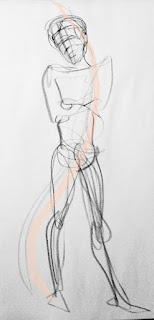
Once I am ready to draw, I spent a few seconds exploring the page and the pose, moving my arm over the paper although I might not start making marks right away. First I check how much room I have on the page, and where the edges of the page are compared to where the farthest out points of the pose are. Then I start with a light mark that will be the frame for the drawing. For the drawings on this post, I've highlighted the first mark I made on each page. Usually it's a swish of a line, the "line of action" as they say. As you can tell, this doesn't really correspond to the spine or to the centre of the figure. It's closest to being a description of the angles of the dominant masses of the figure. If the drawing was an essay, this first line would be the premise. It defines what the page is about.

Once the first line is down, I start putting in lines that support the premise, describing the major masses, starting with the biggest ones and moving out from there. 
 
A gesture drawing is about the tension and energy of the pose. It's not about getting a likeness of the model, it's about getting the attitude they're showing. When you're doing gestures of a good model, then any one of them could be the starting point for a story.

At least, that's the way I approach it. I'm not saying that there's a particularly right or wrong way to do it, just that this is how I do it, and it has worked out pretty well for me so far. See it, Feel it, Draw it. In that order - and that is the important bit.

P.S. Check out http://holmesinccomic.wordpress.com/2011/08/22/gesture-drawings/ for an update to this post.